
Operating Governance
Operating Governance is about how the organization makes, tracks, and enforces key decisions. It’s the “operating system” of the organization. Unlike Corporate Governance, which divides power and responsibilities between the board, management, and other stakeholders, Operating Governance focuses on who decides what, how they make those decisions, and when those decisions should be made. It also includes the metrics which score the outcomes of decisions. Operating Governance defines executives’ power — up, down, and across the organization.
Operating Governance need not encompass every decision or process — only the key ones. The key decisions are those which most affect elements of the strategy: choices shaping the organization’s ability to compete for targeted customers, and to win in the chosen markets. Certain fundamental decisions are almost always key, such as who controls hiring, performance evaluation, sales quotas, and budgets. Others may be less obvious but no less crucial — for example, who defines the market segments; or who enforces technical standards, and how.
Roles, decision rights, and processes often become misaligned after organizational restructurings. The resulting friction and ambiguities (e.g., “but Marketing has always made that decision!”) as people “work it out” in the new organizational structure can lead to costly delays or mistakes in important choices. Getting some help to clarify operating governance can save time, money, and aggravation.
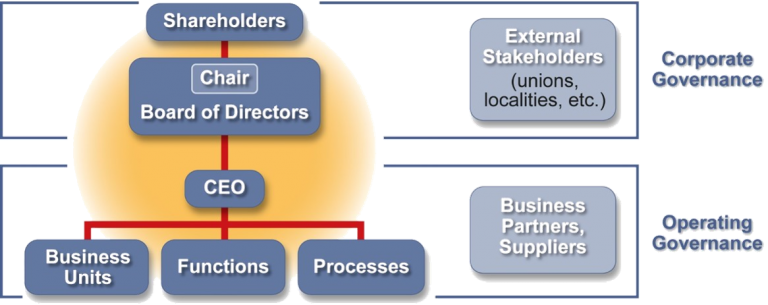
Governance and Decision Processes
How key decisions are made is a process — a process that may span multiple organizations, often with conflicting interests. Many times, that process may be informal, one-off, and only tangentially supported by data. However, more effective decision processes are thought-out, consistent, repeatable, and informed by appropriate data and analysis. And when they are consistent, they can be improved, leading to better outcomes.
It’s not sufficient just to make good decisions, though — it is as important to be able to track the outcomes of strategic choices, as well as actions taken to implement those decisions. Appropriate metrics should be agreed on, and targets specified, when the decisions are made (or as soon as possible).
Finally, it must be in decision makers’ interest to follow through — so incentives should be attached to the metrics. Incentives can be positive (for example, more resources) or negative (for example, fewer resources).
Strategy is most likely to succeed when all of these elements of Operating Governance and Metrics are defined and coherent. Organizations may muddle through with only some of them addressed, but they rarely thrive for long in changing business environments.
Our experience has shown that there are two areas of Operating Governance that tend to be particularly critical — especially when partnering/outsourcing is involved. These are:
- Process governance — for example, product development or manufacturing
- Functional governance — for example, IT’s interactions with the business
Either of these may come into play when companies are involved in partnerships or outsourcing arrangements, either to operate a process or deliver a function. It’s especially important to be explicit about who decides what, when, and how, because the assumed decision rights may be very different in each company.
EXAMPLES of Governance Processes:
- Product Development – processes and funding
- Product Planning, Product Portfolio Management
- Joint Venture Governance
- Product Lifecycle Management
- Collaboration across Regions and Functions
- S & OP
- Order Fulfillment
- Project Prioritization
- New Product Launch
- Knowledge Retention & Sharing
- Complexity Management
- Standards Development & Enforcement
- Capacity Planning
Process Governance
When a business process is of paramount importance (for example, rapid product development when the business strategy relies on bringing products to market faster than competition), it can be valuable to define the governance of that process — especially when success requires the collaboration of multiple functions and/or operating units, within or even across company boundaries.
Business processes requiring effective governance might include, for example:
- Construction and maintenance of a balanced product development portfolio
- Prioritization of projects across the division
- Customer segmentation — including development, reporting, updates
We help you:
- Specify the process, at the appropriate level of detail for the situation
- Define any needed governance bodies (e.g., councils, committees, boards), their memberships, and their operating rhythms
- Collaboratively specify the key decisions and decision rights, for both individual roles and governance bodies
- Develop (as needed) any frameworks, analytics, and/or choice criteria for particular decisions
- Define process metrics and targets
Functional Governance
In many businesses, functional organizations themselves (e.g., marketing, manufacturing, finance, IT), can become very large and diverse, making it challenging to run efficiently and responsively. Even a well-run functional organization can benefit from governance assistance when new capabilities are demanded by the business strategy; when new tools or processes have been deployed; when you must collaborate with a partner to deliver certain functional capabilities; or when you have outsourced certain activities, and must ensure they are delivered seamlessly as part of the function.
We help you:
- Define roles and decision rights to support and reinforce new processes or capabilities
- Assess functional personnel and identify where capability gaps need to be filled
- Define and implement critical decision processes
- Restructure the organization if needed
Client Engagement Examples
IT Governance Framework
The IT function of this multi-billion dollar travel services company was challenged by stability and cost issues, largely driven by uncontrolled complexity, exacerbated by widely distributed IT decision-making.
SOLUTION:
We worked closely with the client’s executive and technology teams to define and implement a cohesive IT Governance Framework by:
- Establishing comprehensive governance processes, encompassing setting and governing technology standards, as well as business unit-driven projects and IT/infrastructure projects
- Restructuring the IT organization, with defined roles, responsibilities and decision rights
- Implementing a “dashboard” of financial and operational/performance metrics for tracking success
- Constructing a feedback loop – such that the organization can continually refine and improve upon their ability to meet their business commitments
RESULT:
The new CIO, assisted by an energized management team (that had been involved in developing the new framework) was able to rapidly realize significant cost savings and operational improvements – while adding new services and reducing complexity.
Governing the Client Relationship
This company’s sophisticated enterprise software requires significant professional services time and expertise to integrate with its customers’ product development processes. Yet, these complex projects had no documented governance mechanisms to help guide them to successful completion. We were engaged to develop these mechanisms in order to better set/manage customer expectations, reduce re-work and improve profitability.
SOLUTION:
Working with key executives and Professional Services personnel globally, we:
- Identified the organization’s key governance choices and determined that a customer-tailored client diagnostic and governance model was required
- Developed the specific elements, including a client diagnostic (to determine appropriate governance “level”) and governance templates (decision rights, processes, metrics, etc.)
- Specified a test and communications plan, developed training materials and conducted training classes for globally distributed Professional Services leadership
RESULT:
An implemented framework that enabled the company’s Professional Services organization to custom-tailor a governance blueprint for each client, based on that client’s needs and capabilities; and to update and improve the blueprint framework as experience accumulates. This program resulted in a measurable reduction in re-work, improved customer satisfaction and increased profitability.
Joint Venture Governance
After completing a JV in China between two leading emissions controls producers (an eos consulting recommendation in a prior engagement), the respective Engineering teams needed assistance in harmonizing their collective product development efforts and leveraging their respective strengths and cost advantages.
SOLUTION:
We worked extensively with the Engineering and Executive teams of both companies to:
- Outline an over-arching vision for how the two organizations should collaborate to co-develop products
- Specify the details of the corresponding governance model for the engineering relationships, including: organizational structure, key operating processes, and decision rights – “who does what, when, and how”
- Determine the costs, ROI and personnel implications of achieving the vision
- Develop a high level transition roadmap/implementation plan, summarizing roadblocks, actions needed, and budgets
RESULT:
Engaged, aligned and collaborative Engineering teams — that led to cost effective, market-leading products – and ultimately to a successful joint venture.
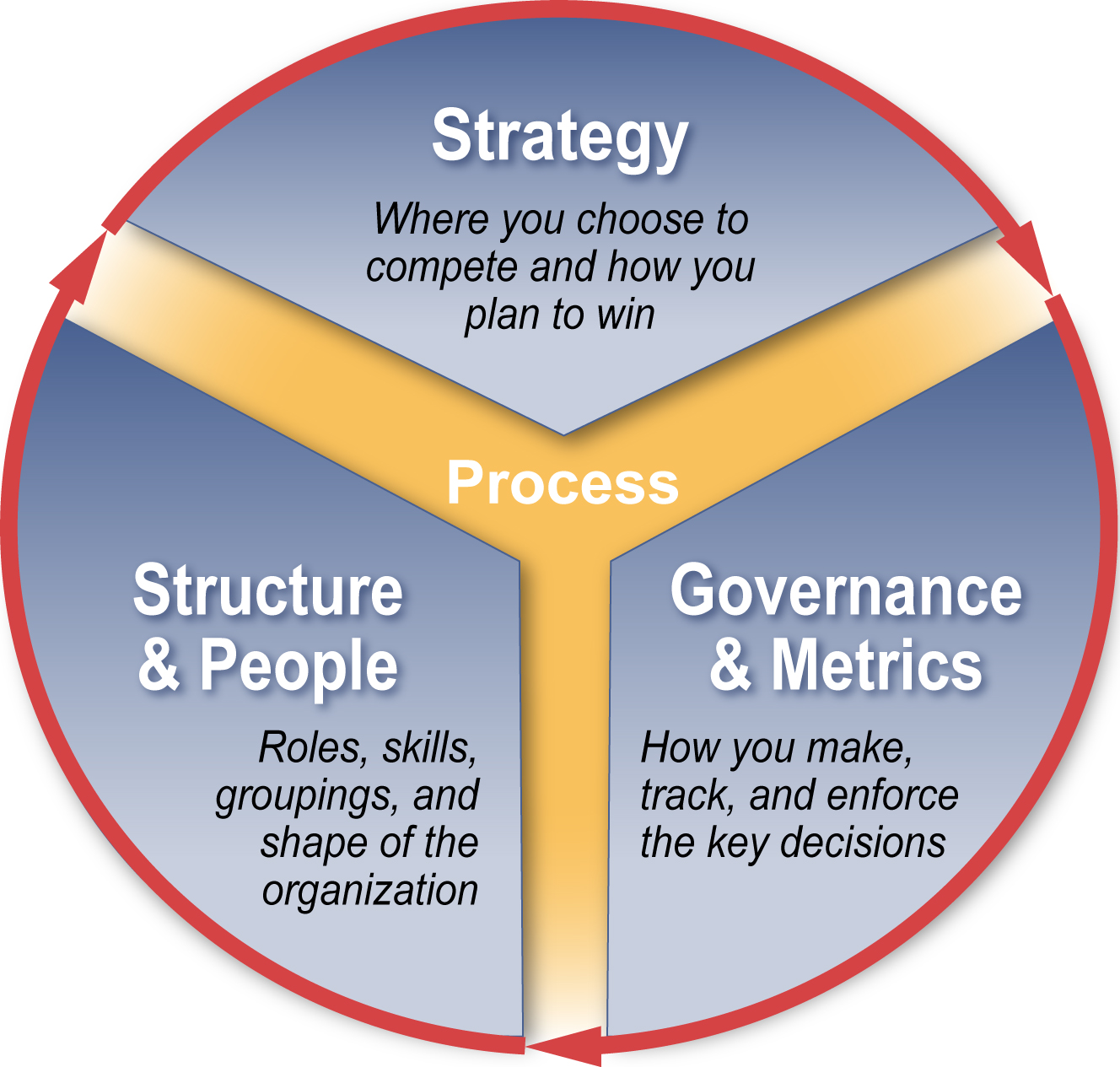
Any of these elements may need to change due to new competitors, changed regulations, different input costs, new technologies, or any of the other myriad ways the business environment is continuously evolving. That doesn’t mean they all must change or that they must change together — successful companies carefully evolve as the environment changes, and we can enter in any of these practice areas to begin to make improvements.
We employ distinctive techniques (such as business wargaming and organizational simulations) across all our practice areas, as well as proprietary frameworks and processes.